Rust solo players can bankrupt the richest clan by infiltrating it and draining its loot from the inside
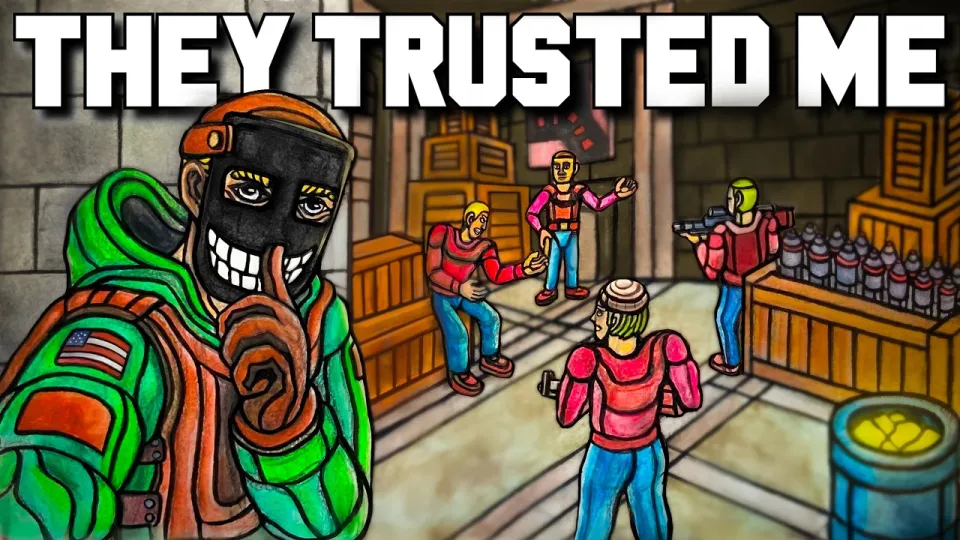
Need articles like this for your video? They help promote it on YouTube and Google — order them in the Telegram bot @sat_sit_bot. It writes articles around your video, embeds the video and publishes them on popular niche websites (no ads). Your first 50 articles are free.
· based on the channel Welyn
Key takeaways
- Welyn spent a full wipe playing a long-form Rust movie built around infiltrating the server's richest clan as a solo player.
- The scheme relied on being useful and friendly inside the clan while moving its resources out of group storage.
- A second solo player, Memelicky, was already running a similar con and the two teamed up instead of competing.
- Clan members reacted in the comments with surprise rather than anger, and one of them confirmed the wipe was fun.
- The video runs across six chapters and was published on July 7, 2026, on the Welyn channel.
Solo Rust players can drain a rich clan's loot without a single rocket by joining it, acting like a loyal member and moving resources out of its storage over time. That is exactly the run Welyn documents in this long-form Rust movie: a solo start, a slow social infiltration of the server's wealthiest group, and a payoff measured in boxes of components rather than explosion damage. Welyn also posts behind-the-scenes material and updates on his Instagram for anyone who wants to follow the next wipe.
The premise is simple and very Rust: the biggest clan on the server has more sulfur, scrap and guns than it can use, and a solo with a rock cannot raid it. The alternative is access. Instead of breaking walls, the solo becomes the player the clan relies on — the one who farms, builds, runs errands and never causes drama — and then converts that trust into loot.
How the Rust infiltration works step by step
The core method is social engineering, not PvP: get inside the group, become useful, then relocate what you can before anyone audits the boxes.
- Start as a normal solo and pick a target clan that is clearly dominant on the server, since a poor clan is not worth the time investment.
- Make contact in a way that reads as friendly and low-threat — offering help, farming, or simply being around without picking fights.
- Earn membership or at least building access, then spend time doing visible work for the group so nobody questions your presence.
- Learn the base layout: where the main loot rooms are, who has code access, when players are offline, and which boxes hold sulfur and components.
- Move small amounts at a time instead of emptying a room, because a missing stack is forgettable and an empty box is not.
- Keep a stash outside the clan base so the loot is already safe if access is revoked.
The critical detail is patience. A clan of ten or twenty players does not notice a few hundred scrap leaving a box that already holds thousands, but it will notice a door blown off. The whole run depends on staying boring.
Why the richest clan is the easiest target in Rust
Wealthy clans are structurally vulnerable because their size creates blind spots in trust. A group that has raided the same solo players repeatedly assumes anyone inside the walls belongs there, and members rarely track individual stacks of resources.
There is also a numbers problem on the clan's side. Big groups recruit constantly to keep farming output high, which means new faces are normal and nobody runs a background check. A solo who volunteers for the tedious jobs — smelting, sorting, hauling — becomes genuinely valuable fast, and valuable members get codes, bags and permission to walk into rooms where the good loot sits.
The economics favor the thief as well. A clan needs thousands of sulfur per raid and stores it in bulk; a solo needs a fraction of that to be set for a wipe. Draining even a small percentage of a large stockpile is a massive upgrade for one player, while the clan absorbs the loss without immediately noticing.
The Memelicky factor and the alliance that made the run
Halfway through the wipe, Welyn discovered another solo already running the same con on the same clan — and instead of sabotaging each other, the two merged their operations. Memelicky had his own history with the group, including being raided by them, which made the partnership personal as well as practical.
The meeting between the two infiltrators became the most-discussed moment of the video. Two players who had each independently decided that the way into a rich clan's vault is through its front door recognized the same instinct in each other. Splitting the work made the scheme safer: one player could keep up appearances inside the base while the other handled movement and stashing outside it.
That alliance is also why the story escalates. A single insider has to be careful about timing and volume; two insiders can cover each other, vouch for one another to clan leadership, and keep the farm looking healthy while the stockpile quietly shrinks. The clan never had a single suspicious player to focus on — it had a functioning team that happened to be robbing it.
What actually goes wrong when you rob a clan from inside
Infiltration runs fail for predictable reasons, and most of them are social rather than mechanical. The most common is overreach: emptying a category of loot in one session, which forces even a distracted clan to check logs and codes.
The second is a loose mouth. Anyone who is told about the scheme can leak it, and in a group of strangers there is always someone with a reason to trade information for favor. A third risk is the audit that follows any internal drama — a kicked member, a failed raid, an argument over who took what — because that is when leadership starts reviewing who has access.
Finally, there is the loyalty trap. The longer a solo spends inside a clan, the more the arrangement starts to resemble an actual job: you farm, you contribute, you get gear handed to you. Several viewers pointed out that the first half of the run looked less like theft and more like employment, where the "stolen" loot was effectively a salary. The line between parasite and member gets blurry fast, and that ambiguity is part of what makes the format work as entertainment.
Typical viewer questions about this Rust strategy
Viewers watching the run tend to raise the same practical doubts: whether the clan ever realized what was happening, whether the loot was worth the time compared with just farming, and how much of the outcome depended on luck with the people involved. The clan side of the story came out in the comments, where members of the group confirmed they had enjoyed the wipe and treated the whole thing as good-natured chaos rather than a betrayal worth retaliating over.
Another recurring theme is whether the format is repeatable. It is, but the difficulty scales with server culture: on a server where clans are paranoid, code access is restricted and members are vetted, the infiltration takes far longer and the margin for error is much smaller.
Community reaction and the channels behind the run
Reaction to the movie centered on the two-solo alliance and on the absurdity of a clan being drained by people it had invited in. The most repeated sentiment was a demand for more of Memelicky, whose deadpan approach to being raided by the same group three times without being remembered landed as the funniest line of the video.
A clan member who appeared in the comments confirmed the wipe was enjoyable from the inside, which reframes the whole genre: the victims of a good con often get the better story. Other viewers compared the scheme to comedy sketches about robbing a bank by getting a job there, and several said the run made them want to reinstall Rust.
Links from the video
Final thoughts on draining a clan in Rust
The run works as a case study in why Rust is as much a social game as a survival one: the richest group on the server lost more to trust than it ever would have to C4. Welyn structures the story across six chapters, from the first friendly contact to the handshake with a rival infiltrator and the final accounting of what left the base. The takeaway for solo players is that access beats explosives when the target is bigger than you, and the takeaway for clans is that the quietest member is worth auditing. If you want more of these wipe-long stories, follow Welyn on Instagram and keep an eye on the channel for the next one.
Questions & answers
Can a solo player really drain a large Rust clan's loot?
Yes, but through access rather than force. A solo who joins a clan, becomes useful and moves small amounts of resources over time can take far more value than they could ever raid, because a large group rarely audits individual stacks. The risk is social: codes get changed and trust gets revoked once anyone becomes suspicious.
Did the clan in the video ever find out what was happening?
The group's own members showed up in the comments and treated the wipe as fun rather than a disaster, which suggests the reveal came after the damage was done. The run was framed as a long con with a payoff at the end, not a silent theft nobody noticed.
Who is Memelicky and why does he matter to the story?
Memelicky was another solo running a similar infiltration against the same clan, and he had already been raided by them multiple times without being remembered. Instead of competing, the two players combined their schemes, which made the operation safer and produced the video's most-quoted moment.
Is infiltrating a clan worth it compared with just farming in Rust?
It depends on the server. Against a dominant clan with open recruitment, the loot per hour can beat farming by a wide margin, since you are moving resources that dozens of players gathered. On a paranoid server with vetted membership and restricted codes, the time investment usually outweighs the payoff.
Source: I Secretly Drained Loot from the RICHEST CLAN - Rust (Movie) · Markdown version